
Checking a boat engine: what you can test yourself before buying
Reading time: about 22 minutes
On a used boat, damage to the engine or the drive is the item that gets expensive fastest. On a cheap boat an overhaul can cost more than the whole boat is still worth, and on the water a failing engine quickly becomes a safety matter.
This also applies to the inboard diesel in a sailing boat, with a shaft or saildrive; what the saildrive adds is covered below.
You can spot much of this yourself as a layperson, without unscrewing anything: with the right questions, a close look in the engine bay, a cold start and a sea trial or test sail that really works the engine. This article takes you through it in the order a viewing runs. It does not replace an engine survey, but it tells you when you need one.
1. Before the viewing: the engine’s history
When you arrange the viewing, ask the seller not to start the engine before your visit. You want to check it cold, because any engine starts more easily when warm, and weaknesses in starting and compression then go unnoticed. If the engine block does not feel cold when you arrive, ask why it has been running.
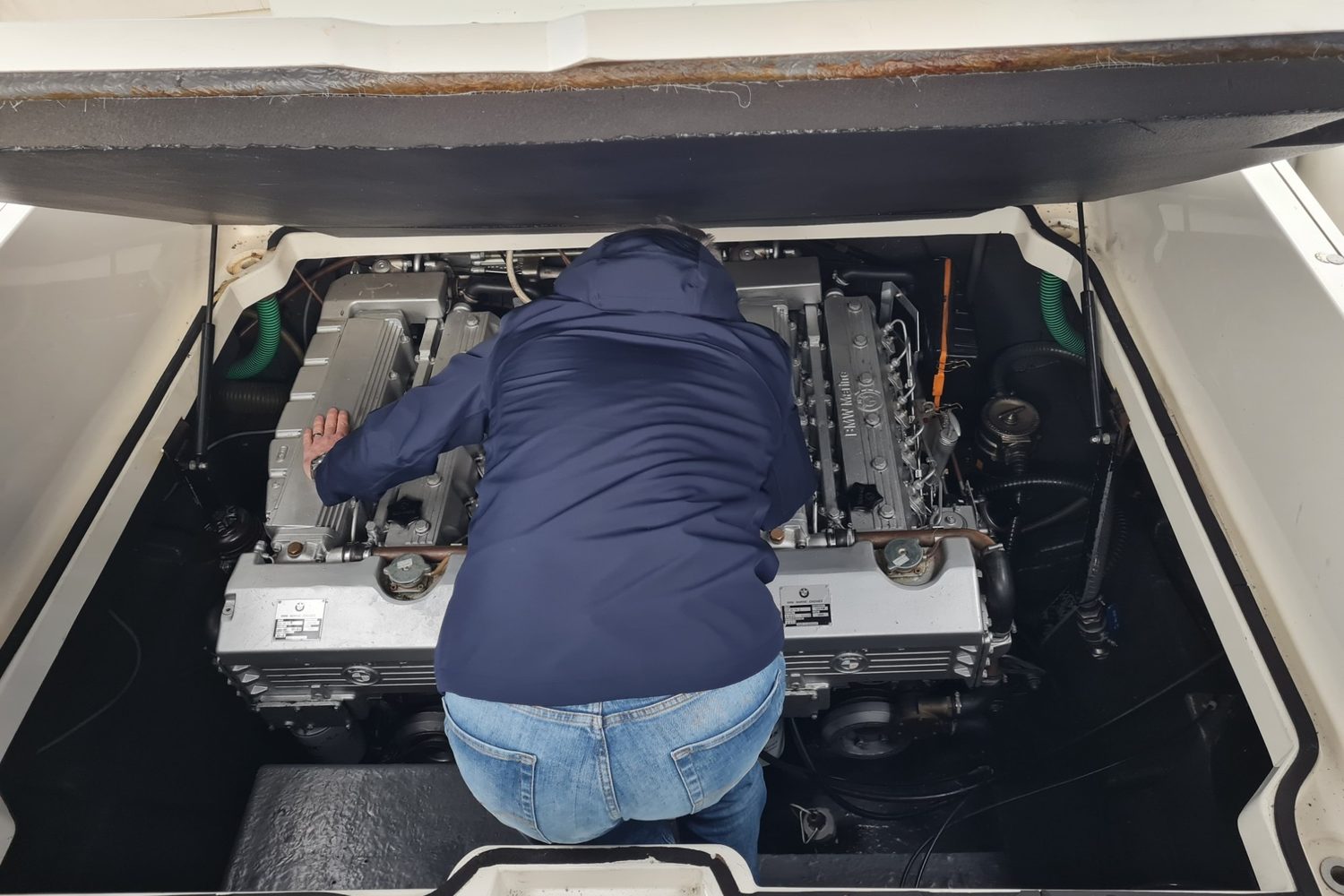
Put your hand on the engine block: if it is not cold when you arrive, ask why it has been running.
In conversation you often learn more than from the hour meter. A figure for hours says little unless you know how the boat was run. A diesel wants to get warm regularly and run under load. If for years it was almost only run briefly and at low throttle, it cokes up: carbon builds up in the combustion chamber and exhaust path, and power falls off, even if the meter still shows few hours.
So also ask how the engine is warmed up. Letting it warm up at idle at the pontoon is not ideal. It is better to run for about 15 minutes at 1,200 to 1,500 rpm after casting off and only then open the throttle.
The questions you should ask
- How was the boat mostly run: short trips at low throttle or longer runs under load? And how is the engine warmed up?
- Who did the maintenance, the owner or a professional yard? Are there invoices or a maintenance log?
- What did maintenance include apart from oil and filters: cooling system flushed, impeller changed, engine anodes renewed, heat exchanger cleaned?
- Did a professional yard do only what it was asked to, or everything the manufacturer specifies for this engine?
- Have there been repairs to the engine, gearbox or drive, and who did them?
- Is an additive against diesel bug added to the fuel as a precaution?
- How can the gearbox oil be checked on this drive? (More on this in chapter 3.)
- Why is the boat being sold?
If an invoice shows only materials, it is unclear who did the work. That need not be a defect; some owners maintain their boats carefully themselves. But then there should be records, with dates.
2. In the engine bay: what you can see without tools
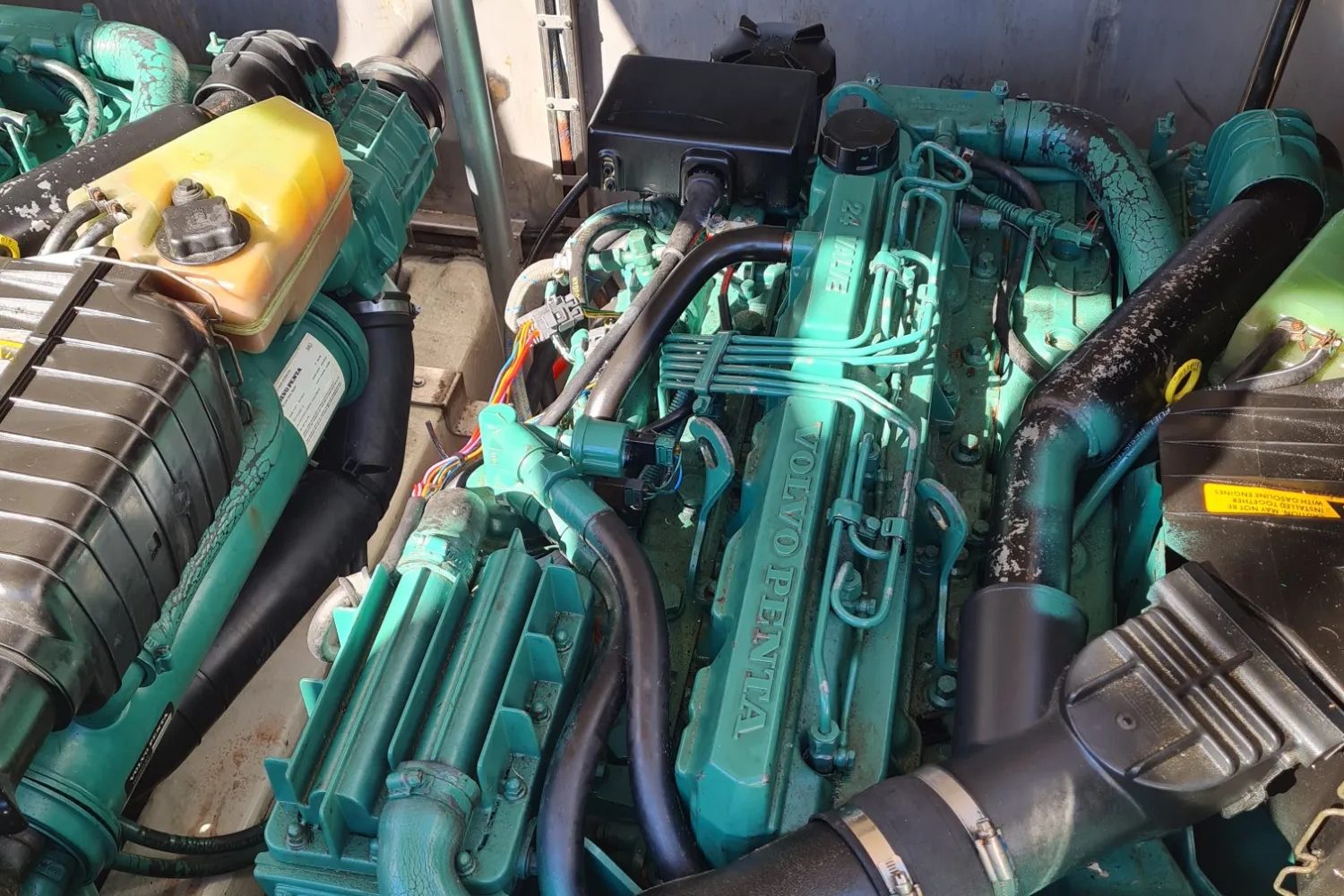
Look for dust, an oil film and rust on the ancillaries, and for crusts on hoses and clips.
Take a torch; the engine bay is almost always cramped and dark. The checks here use only your eyes, nose and hands.
Upkeep
Dust, an oil film and rust on the ancillaries suggest that maintenance was not done carefully either, especially if there is no maintenance log. But an engine bay that looks freshly scrubbed deserves a second look too: sometimes something was quickly “wiped away” before the viewing. A little dust is not a bad sign.
Access
See whether the parts that need servicing can be reached at all: filters, impeller pump, heat exchanger, drive belt. If a part can hardly be reached, it was probably never touched, or too rarely. A boat near ours on the pontoon shows how far this can go: to change the turbochargers, both engines had to come out of the boat. A second clue is painted bolts. If the paint on the bolt head has no crack, the bolt was never undone and the part beneath it was probably never opened.
Leaks: salt water, oil, coolant
- Salt water leaves white crusts and corrosion. Typical places are the heat exchanger end caps and the exhaust manifold. A manifold that has rusted through must be replaced, and how expensive that gets also depends on how easy it is to reach. If it is being changed anyway, consider a stainless steel manifold; it lasts much longer.
- Oil is not always the same story. A damp rocker cover on an older engine is common and is sorted with a new gasket. If, on the other hand, the oil is coming out of the flywheel housing at the back of the engine, the rear crankshaft oil seal is usually leaking. The seal itself is cheap, the work is not, because engine and gearbox usually have to be separated for it.
- Coolant shows up as a trace or crust on hoses and clips.
Oil and coolant
Pull the dipstick and, with the engine cold, open the header tank cap. Level and colour both count. Milky oil or cloudy, oily coolant means the two are mixing; one possible cause is a failed head gasket, and that is a major repair. A look under the oil filler cap belongs here too: light brown sludge there is an early sign of water in the oil.
Some owners swear by the oil spot: put a drop from the dipstick on paper or card and read the spot. A wide, pale ring around the spot points to fuel in the oil, a dark, sharply defined core to sludge. It is no more than a clue. The spot can be read only hours later, only a laboratory can reliably detect coolant in oil, and when buying, a single spot says little: after a fresh oil change almost any engine looks good.
Belts, cables, mounts
- Black dust around the pulleys often means the pulleys are not running in line. Then even a new belt will quickly wear away again.
- Amateurishly patched cables, lines that have gone hard from diesel, a torn air filter, cracked hoses or rusty clips show how carefully the boat has been looked after.
- The engine mounts, the rubber feet the engine stands on, must be neither cracked nor softened.
Fuel: pre-filter and diesel bug
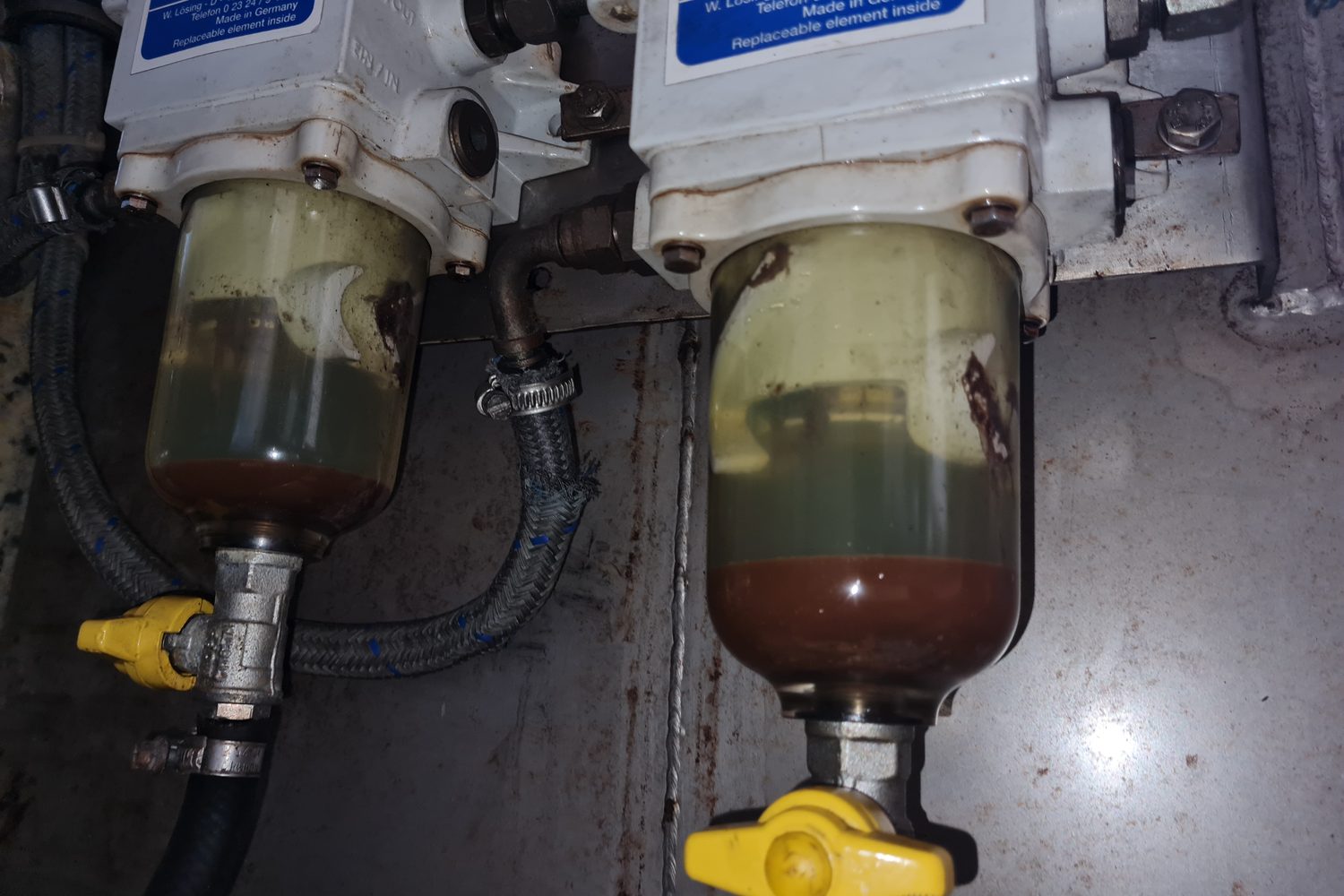
In the right-hand sight glass dark sludge has settled at the bottom: a sign of diesel bug.
If the engine bay smells of petrol or diesel, nothing gets started until the cause has been found. On petrol engines the engine bay blower runs first before every start. If the pre-filter has a sight glass, look into it. Diesel bug is made up of microorganisms that live in the tank and clog filters; black, slimy residue in the glass points to it. If the filter has just been changed, the glass says something only after the sea trial, so you look again then.
3. The drive: different weak points depending on the design
The engine is only half the bill. What sits between engine and propeller has its own weak points and its own service intervals, depending on the design. What has to be changed and when is set out in Motorboat running costs, for saildrive and shaft on a sailing boat in Sailing yacht running costs; here it is about what you see at the viewing. Much of this works only when the boat is ashore. If it is in the water, ask whether it can be lifted out for the viewing, or whether there is a recent survey with photos of the underwater hull.
For all drives
- Anodes: If anodes are worn, they are doing their job. If they still look new after years, they may have been painted over or have no contact, and then corrosion attacks the drive itself. Pitted drive parts or shafts point to poor corrosion protection.
- Propeller: Bent or kinked blade edges usually come from touching the bottom. A propeller out of balance harms bearings and seals in the long run. Also look at the shaft directly behind the propeller: fishing line that winds itself up there destroys the shaft seal, and oil at this spot shows it has already happened.
- Gearbox oil: Healthy oil is amber to golden brown. Grey or milky means water in the gearbox, silvery shiny particles mean wear on bearings or gears. Either is a reason to call the marine engineer, who then checks the seals with a pressure test. Find out before the viewing whether and how you can check it on this drive. On a sterndrive this generally works only when the boat is out of the water; some designs have a reservoir in the engine bay where you can see level and colour.
- Gear shift: With a mechanical shift using cables, the lever must move easily and click noticeably into each position. If it sticks or goes stiff, often only the control cables are worn; if it is not them, the problem is in the gearbox. An electric shift always moves easily, so there the lever tells you nothing.
- Electronics: On electronically controlled engines and drives, the control unit stores faults and operating data. Ask for a recent printout from a specialist workshop; it often says more than the hour meter.
Sterndrive
The sterndrive passes through the transom, and at this point only rubber bellows keep the water out. Depending on the design there are two or three: always the universal joint bellows around the drive shaft and the exhaust bellows, on some designs also one around the shift cable.
A leaking bellows is not just damage to the drive, it can sink a boat at its berth.
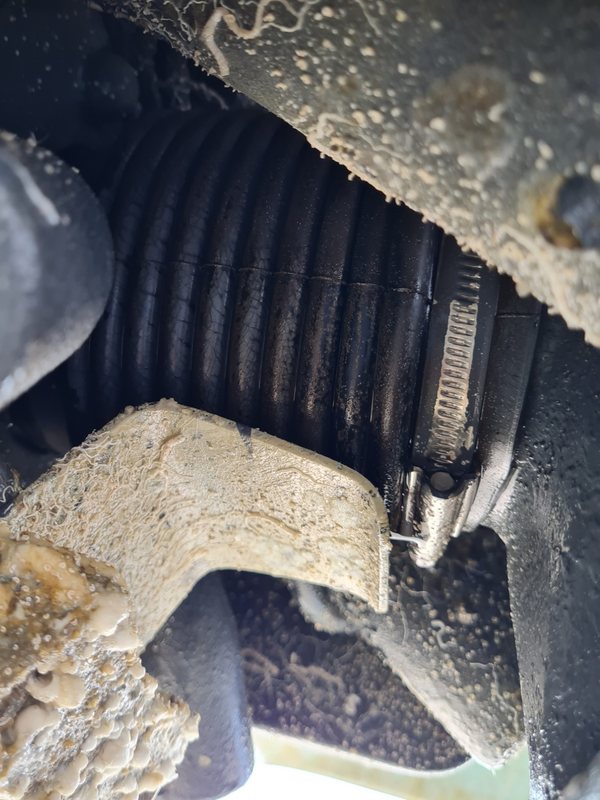
- Ashore, have the drive moved fully left, right, up and down, and look at the bellows all round with the torch, especially in the folds. Cracks, brittle rubber, growth of mussels or barnacles and rusty or loose clips are warning signs.
- In the boat, look for traces of water on the inside of the transom and in the bilge. Ask whether the bilge pump often cuts in.
- Ask for the date of the last bellows change, with the invoice, and whether all bellows were changed then. For the universal joint bellows the drive has to be removed, and that is exactly why it tends to get left out.
- Look at the hydraulic hoses for trim and steering: no cracks, no oil on the rams. With two drives, the tie bar between them must be straight and firm.
- On the sea trial the drive must rise and fall evenly on the trim, and the steering must be light. If it is heavy, the power assist is missing.
Shaft drive
On a shaft drive the shaft leads outside through the stern tube, sealed by a stern gland or a mechanical shaft seal. Leaking stern glands, old stern tube hoses and rusty clips are a typical cause when a boat takes on water at its berth.
- Ashore: Grab the propeller and shake it hard up, down and sideways. If you feel movement between shaft and bearing or hear a clack, the bearing is worn. Fore and aft the shaft must not move at all; if it does, the propeller or coupling is loose or the gearbox is worn.
- Turn the propeller by hand with the gearbox in neutral. If it is stiff, the shaft may be bent or engine and shaft may be out of line. A marine engineer then measures that.
- In the boat: Check the stern tube hose between stern tube and seal for cracks or soft spots and look at the clips all round. They rust from underneath first; a mirror helps. A flexible shaft coupling, if fitted, must have no cracks in the rubber.
- Stern gland: When the shaft is stationary it must be watertight. When the shaft is turning, a few drips a minute are intended; they cool and lubricate. A steady trickle is too much. If remains of grease or packing lie beneath it, the gland has probably been tightened too hard, and in the long run it grinds into the shaft. Feel with your finger whether the shaft has a groove where it enters the stern gland.
- Mechanical shaft seal: The bellows must have no cracks and no brittle areas, the clips no rust. If the seal squeals in use, it is getting too little water.
- After the sea trial: Shaft and seal must not be hot; you must be able to keep your hand on them.
Pod drive
Pods sit under the hull, with their own oil, their own electronics and their own propellers. What harms them most cannot be seen from above: a grounding or floating debris.
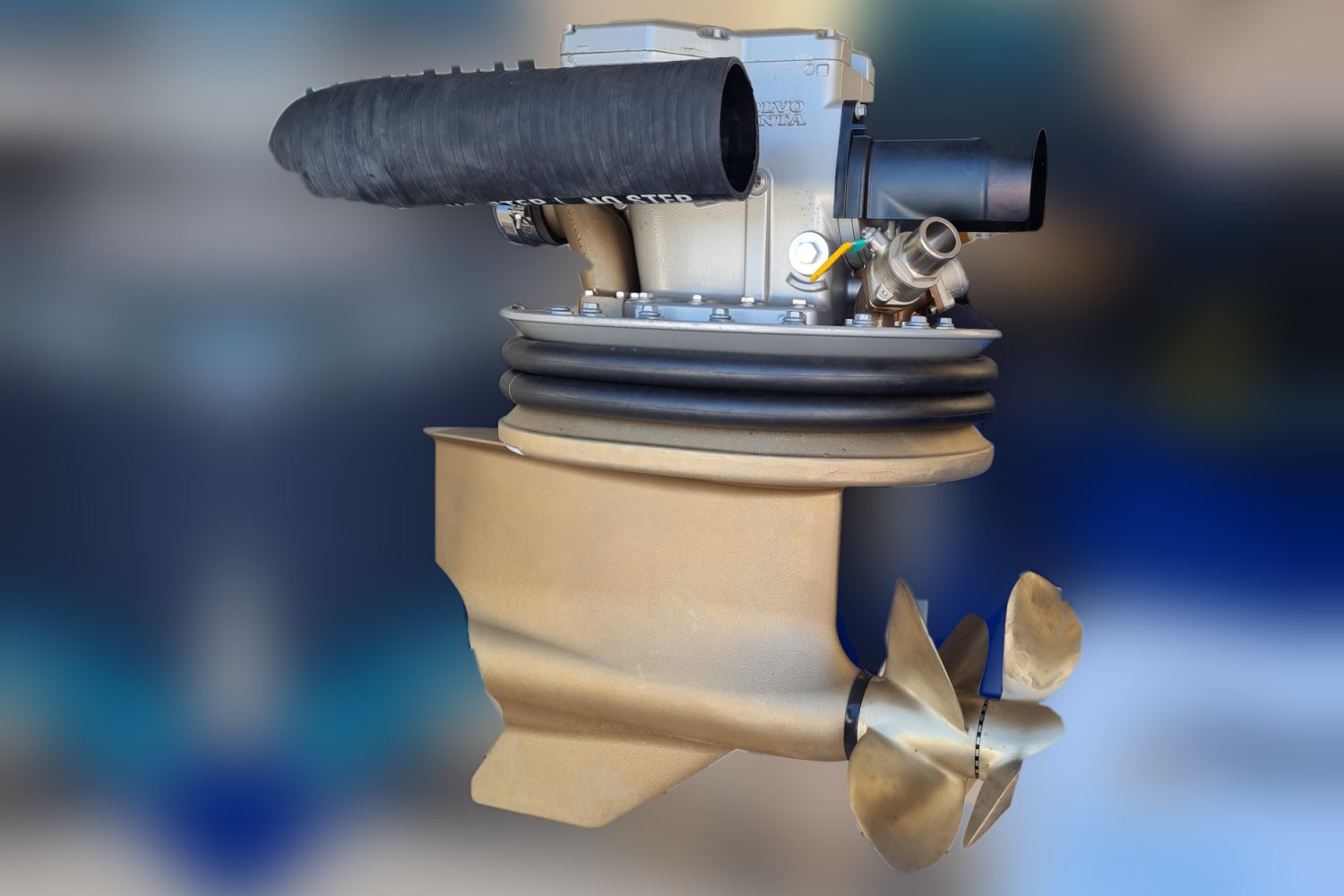
The gold section sits under the hull in the water. You can check it only with the boat ashore.
- Ask explicitly whether the boat has ever touched the bottom. After any grounding the manufacturer requires a check with the boat ashore; have them show you that it was done.
- Ashore: look at the propellers for nicks, the housing for damage and the gap between pod and hull for corrosion. A damaged propeller left in place puts the pod at risk.
- The pod oil shows the correct level only after standing for a longer time, so ideally before the first run of the day. Golden brown is good, thin and greyish means water.
- Watch the display for messages about oil level or water in the oil, and check the steering at every helm station, with the joystick if fitted.
- Have them show you the service records under the manufacturer’s schedule, plus a printout of the fault memory. Some work on the pod can be done only with the boat ashore; that belongs in the sums.
Outboard
With an outboard you see more from the outside than with any other drive, and you can check much of it yourself.
- Lean your weight on the engine: the transom must not give.
- Tilt the engine up. It must stay up, and there must be no oil on the outside of the trim and tilt unit.
- Check the gear oil before the engine has run: after running, air bubbles look milky without any water being in it. Fine metal dust on the magnet of the drain plug is normal, larger pieces are not.
- Take off the cowling: water or traces of leaks beneath it are a warning sign, as is milky engine oil or an oil level that has risen.
- Read the year of build on the transom bracket and compare it with the figure in the listing. You will need the serial number later for spare parts and recalls.
- In the water: cooling water must come out of the tell-tale after starting. Some engines show hardly any stream at idle; with a little throttle it must be strong.
Saildrive
On a sailing boat with a saildrive, the rubber diaphragm between drive and hull is the critical point. Look at it inside the boat for cracks and at the clamping ring for rust, and ask for the date of the last change. Healthy oil is clear and yellowish, grey or milky means water. The aluminium housing needs intact paint and an antifouling suitable for aluminium.
4. The cold start
Before starting, lay a light-coloured, absorbent cloth under the engine and take it out only after the sea trial; every drop that falls in the meantime will show on it. With two engines, start one after the other. That way, if there is smoke or a noise, you know where it is coming from.
A healthy diesel starts immediately after pre-heating, with no long cranking and no stuttering. Any delay is a warning. The oil pressure and charging lights go out after starting, and the coolant temperature settles in the normal range after warming up. Then go to the stern: cooling water must come out evenly with the exhaust, at idle too. If there is only a thin trickle, something is wrong with the cooling system.
What the colour of the smoke tells you
| Colour | Harmless if | Otherwise a sign of |
|---|---|---|
| White | it is steam in cool weather that disappears after warming up | water in the combustion chamber, for example from a failed head gasket |
| Black | it appears briefly in the first few seconds on older diesels | incomplete combustion: clogged air filter, injection, or an engine working against too large a propeller |
| Blue | it is a cold two-stroke with oil mixed into the fuel | burnt engine oil, for example from worn piston rings |
On engines with electronically controlled injection, practically no smoke should be visible after starting. If there is some, ask about it.
5. The sea trial or test sail: working the engine
Many checks are possible only on the water. If the boat is ashore or in winter storage, it is usually better to put the sea trial or test sail off until spring than to buy without one. Do not go alone, and take an infrared thermometer for the cooling test.
Casting off
While the seller takes the boat out of the harbour, look at the running engine. What vibrates or rattles need not be the engine; a worn bearing on an ancillary such as the alternator shows itself the same way. As a guide: if it vibrates even at idle, the engine or the engine mounts are the more likely cause; only in gear, the propeller or shaft; only at certain revs, often an unbalanced propeller. If the boat has two engines, compare them with each other. And use your nose: fuel, hot rubber or scorched cables have no place in a healthy engine bay.
Then ask the seller, at slow speed ahead, to shift briskly through neutral into astern. If the engine stalls, the cause may be the drive or the propeller set-up. Then go astern with a little more throttle and look at the engine mounts: if the engine moves much more than when going ahead, they are worn.
Warm up, then full throttle
Once the engine has reached operating temperature, it may also run at full throttle for a few minutes. That is what it is built for, and a healthy engine comes to no harm.
What shows up under full load is not caused by the test; the test makes it visible.
Look out for three things:
- Revs: Does the engine reach the rev range the manufacturer states at full throttle? If it stays below, the propeller is too large or the engine lacks power. If it revs well above, that points to a propeller that is too small or damaged. You will find the range in the operating manual; otherwise ask the manufacturer or a specialist workshop.
- Temperature and oil pressure: The coolant temperature must stay in the normal range even at full throttle, and the oil pressure must not drop. If the temperature rises, a heat exchanger clogged with scale or a tired impeller may be the cause, and you come back to the questions about maintenance. How to check the cooling more closely with the thermometer is in the next section.
- Air: An engine needs a lot of fresh air. If you open the engine hatch and feel a clear suction, or the revs pick up as you do, too little air is reaching the closed engine bay. That is not down to the engine but to the ventilation of the installation, and in the long run the engine suffers.
On planing boats, how the boat gets on the plane is part of this. If the stern stays low for a long time and the bow points up, the engine may be too weak; then it struggles on every trip, all the more so with luggage and a full crew.
The cooling: the thermometer test
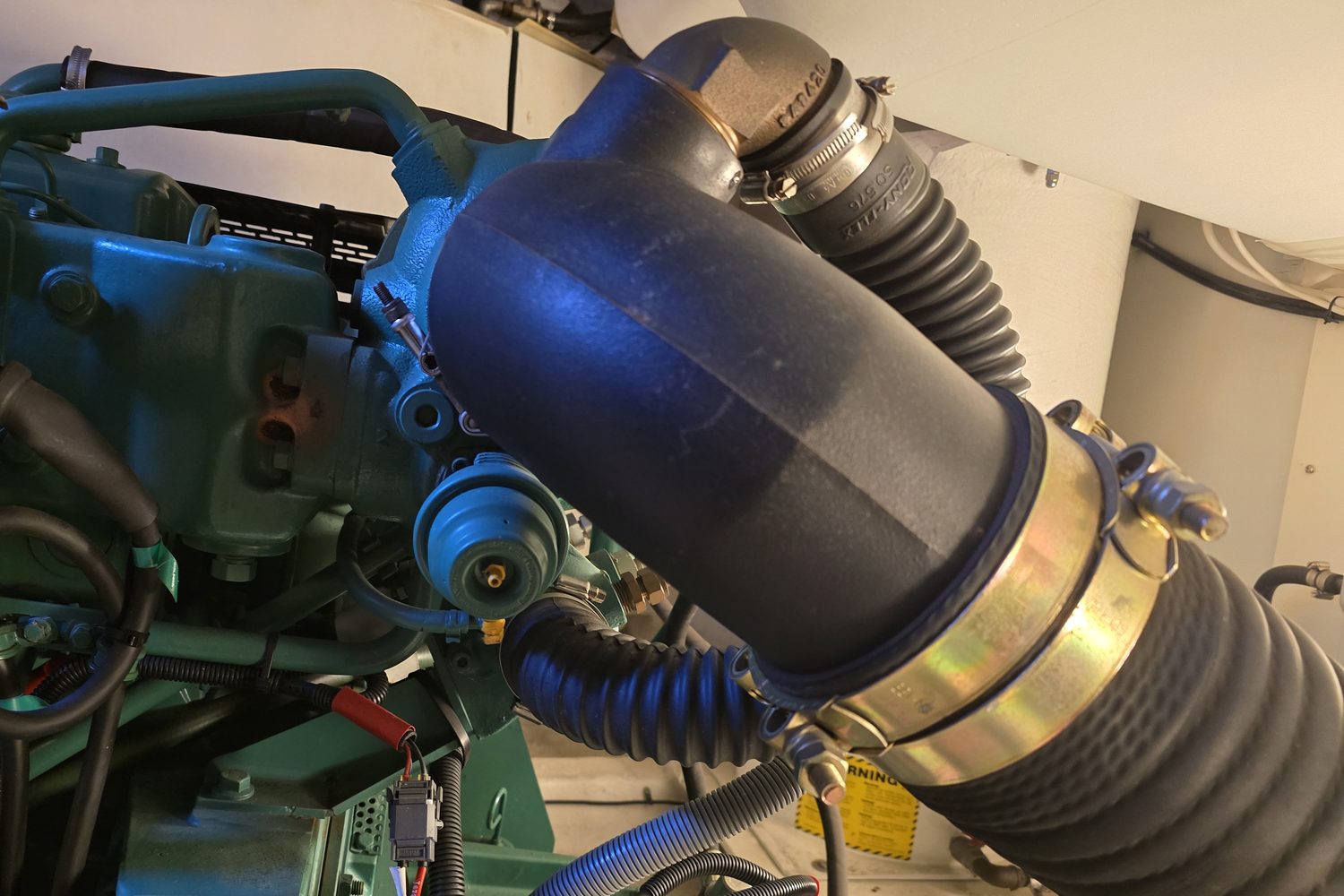
The exhaust hose leaves at the exhaust elbow: look for crusts, cracks in the hose and rusty clips.
From countless rounds of boat chat over a beer we know: boat engines mostly die of their cooling, not of a forgotten oil filter.
That is why an infrared thermometer belongs on the sea trial. It measures without contact, and you need it for only two checks.
- Equally warm: After a longer run under load, on a planing boat after running on the plane, when the engine is properly warm, measure the exhaust manifolds. If the engine has two manifolds, like a V engine, or the boat has two engines, the readings must be about the same. If one side is markedly warmer, something is wrong in the cooling system.
- Touchable: You must be able to touch a water-cooled manifold briefly by hand, even after a long run and after running on the plane, without burning yourself. If it is not, the cooling is too weak. Measure with the thermometer first, and do not touch the turbocharger or uncooled parts of the exhaust path: they can get very hot even on a healthy engine.
A simple test for wear
A compression test means opening up the engine, and many sellers rightly refuse. You can get a clue without tools: with the engine running under load, briefly take off the oil filler cap or pull the dipstick out a little. A little air escaping there is normal. If it blows hard, a lot of combustion gas is getting past the piston rings into the crankcase, and then a proper compression test is worthwhile.
6. Back at the pontoon
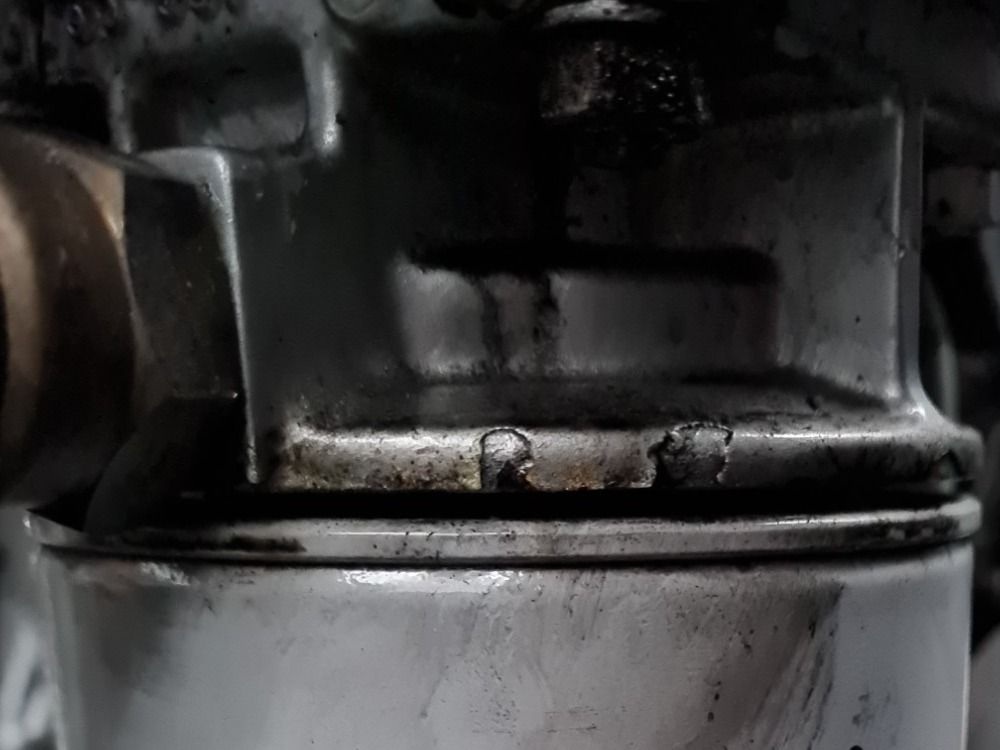
Streaks on the oil filter: it is leaking a little here.
- Take the cloth out from under the engine. New stains show you where it is dripping.
- Look into the bilge: if it was dry before and is now wet or oily, there is a leak.
- Take another look into the sight glass of the pre-filter.
- Feel the shaft, stern gland and drive as far as you can reach: warm yes, hot no.
- If you did not measure the exhaust manifolds under way, do it now while the engine is warm.
If you want to know more, have samples of oil and coolant taken from the warm engine and tested in a laboratory. Such an analysis is most useful when it is repeated year after year. A single sample only shows you whether anything unusual is in it at the moment.
7. When a marine engineer has to step in
With some findings it is no longer about a price reduction. Then you bring in a marine engineer, and the purchase is an option only on markedly different terms, or not at all:
- water in the engine oil or gearbox oil
- an engine that overheats at full throttle or does not reach its revs
- exhaust manifolds that are markedly different in temperature or cannot be touched after the run
- an engine that struggles to start from cold
- blue smoke that does not go away when warm
- oil on the water behind the boat
- shifting problems that are not down to the control cables
- corrosion and dirt all over the engine
The counter-example: a clean engine with a complete maintenance log that starts from cold immediately and with almost no smoke, reaches its revs at full throttle and stays cool doing so is very probably healthy. That is not certain, and even a survey with a compression test gives you no such assurance.
With large, expensive engines a separate engine survey is worthwhile. An ordinary pre-purchase survey often looks at the engine only while it is running. If you want to know more, look for an engine specialist who also offers a compression test. For every repair they find, get quotes from several boatyards, because prices for the same work vary widely. And if there are no longer any spare parts for an old engine, a replacement engine can be the better solution.
8. When buying a share: the findings concern everyone
If you buy a share, the engine does not belong to you alone, and you do not pay for a later repair alone either. Costs such as maintenance, repairs and reserves are borne by the co-owners in proportion to their shares (more on this in Contract for boat co-ownership). For the check that means two things:
- If you are forming a new co-owner group, you check together. What one person misses, another finds, and you share a survey.
- If you are joining an existing co-owner group, ask for the shared maintenance log and the logbooks, the size of the reserve and which larger jobs are in sight. An overhaul due next year is then yours too.
The remaining points, from the papers to the handover record, are in the Checklist for buying a boat.
Conclusion
Whether an engine is healthy shows in three places: in the paperwork, at the cold start and under load, and there above all in the cooling. If you take these three seriously, you will see most expensive damage before you sign, and you will know when you need to bring in a marine engineer. Plan enough time for the viewing, ask for data rather than impressions, and insist on a sea trial or test sail that really works the engine, even if the seller would rather just do a lap of the harbour.
View all boats Checklist for buying a boat Boat chat All guides
About the author: Ekki is the founder of PartABoat and a co-owner of two motorboats, one in Croatia, the other on the Rhine. The check points in this article are compiled from specialist literature and manufacturers’ information; the cooling test and the advice on warming up are based on his own experience. They do not replace a survey and are no assurance of the condition of an engine.