
Sailing yacht running costs: what rig and sails really cost
Reading time: about 14 minutes
What does a sailing boat cost per year? In short: more than most people think. In this article you will find every single item with concrete figures, broken down by cruising area and type of boat, plus a long-term calculation over 10 years.
All examples are based on the Bavaria Cruiser 41 (built 2015, approx. 12.5 m), a sailing boat typical of PartABoat. The rule of thumb is the one we work with at PartABoat; the other figures are guide values from market research, not a promise.
1. The rule of thumb, and what it covers
The rule of thumb for sailing boats:
Annual running costs = boat length (in metres) × cost factor
| Cruising area | Cost factor, sailing boat |
|---|---|
| Croatia / Adriatic | approx. €1,000 per metre per year |
| Germany / inland | approx. €600 per metre per year |
Source: guide values from market research.
For a Bavaria Cruiser 41 (approx. 12.5 m) in Croatia that means around €12,500 a year. For a 10 m sailing boat on German inland waters, around €6,000.
The rule of thumb covers: berth, insurance, routine maintenance (antifouling, engine service, rig check) and minor repairs. In Germany and on the Baltic, winter storage ashore comes on top; not in Croatia, because boats there as a rule stay in the water and the winter berth is already part of the annual berth. It does not cover: fuel, larger repairs (engine overhaul, osmosis treatment, re-rigging), upgrades (new electronics, upholstery), travel there and back, and equipment.
So that you know what is behind the figure, we break down every item individually.
The rule of thumb explained in detail: What a boat really costs: the honest calculation
2. Why a cheaper boat is not cheaper to run
The rule of thumb from chapter 1 contains no purchase price. It works from length, and that is no accident: berth, lifting out, winter storage and antifouling are charged by length and area. Only the hull insurance premium depends on value, and that falls with age anyway. If you buy cheaper, you pay less for the boat, but not less in running costs. With age it is not the routine costs that rise; what happens is that the items from chapter 4 fall due.
| ¼ share in a Bavaria Cruiser 41, built 2015 | Alone: 12 m boat, built 2000 | |
|---|---|---|
| Upfront costs | approx. €25,000 | approx. €20,000 |
| Running costs per year | approx. €3,125 | approx. €12,000 |
| Total after 5 years | approx. €40,625 | approx. €80,000 |
Source: running costs from the rule of thumb in chapter 1; purchase price of the Bavaria Cruiser 41 from market research, the boat from 2000 is a worked example.
Not included are fuel, incidental purchase costs and the residual value after five years. Neither column contains a major item, and on the boat from 2000 considerably more of them are due. That does not mean older boats are not worth it; a well-kept boat with a documented history is often the better buy. It only means that the purchase price says little about what the boat costs you per year.
3. All cost items in detail
Berth
The largest single item. For a sailing boat of 12–13 m:
| Cruising area | Annual berth (approx.) |
|---|---|
| Croatia (ACI and private marinas, winter afloat included) | €5,500–11,000 |
| Baltic (Flensburg, Kiel, Rügen) | €1,700–3,800 |
| Lake Constance | €1,500–7,000 |
| Germany inland (Rhine, Moselle, Mecklenburg Lakes) | €1,500–3,500 |
Source: price lists of marinas and harbours for 2026, checked in October 2026.
Municipal berths in Croatia cost only a few hundred euros a year. By law, however, they go only to boats that are registered in Croatia and lie there most of the time, and locals take priority.
Lake Constance berths often have waiting lists of several years, and some harbours no longer take anyone on. If you have one, you do not give it up lightly. A berth does not, as a rule, pass with the boat, here or anywhere else.
Insurance
Third-party liability: Approx. €120–300/year. Indispensable; many marinas require it as a condition.
Hull insurance: 0.5–1.5% of the insured value. For a Bavaria Cruiser 41 (value approx. €100,000): €500–1,500/year. Depends on cruising area, cruising limits, excess and the skipper’s experience.
Typically together: Approx. €800–1,500/year for a sailing boat between 7 and 17 metres.
Antifouling and underwater hull
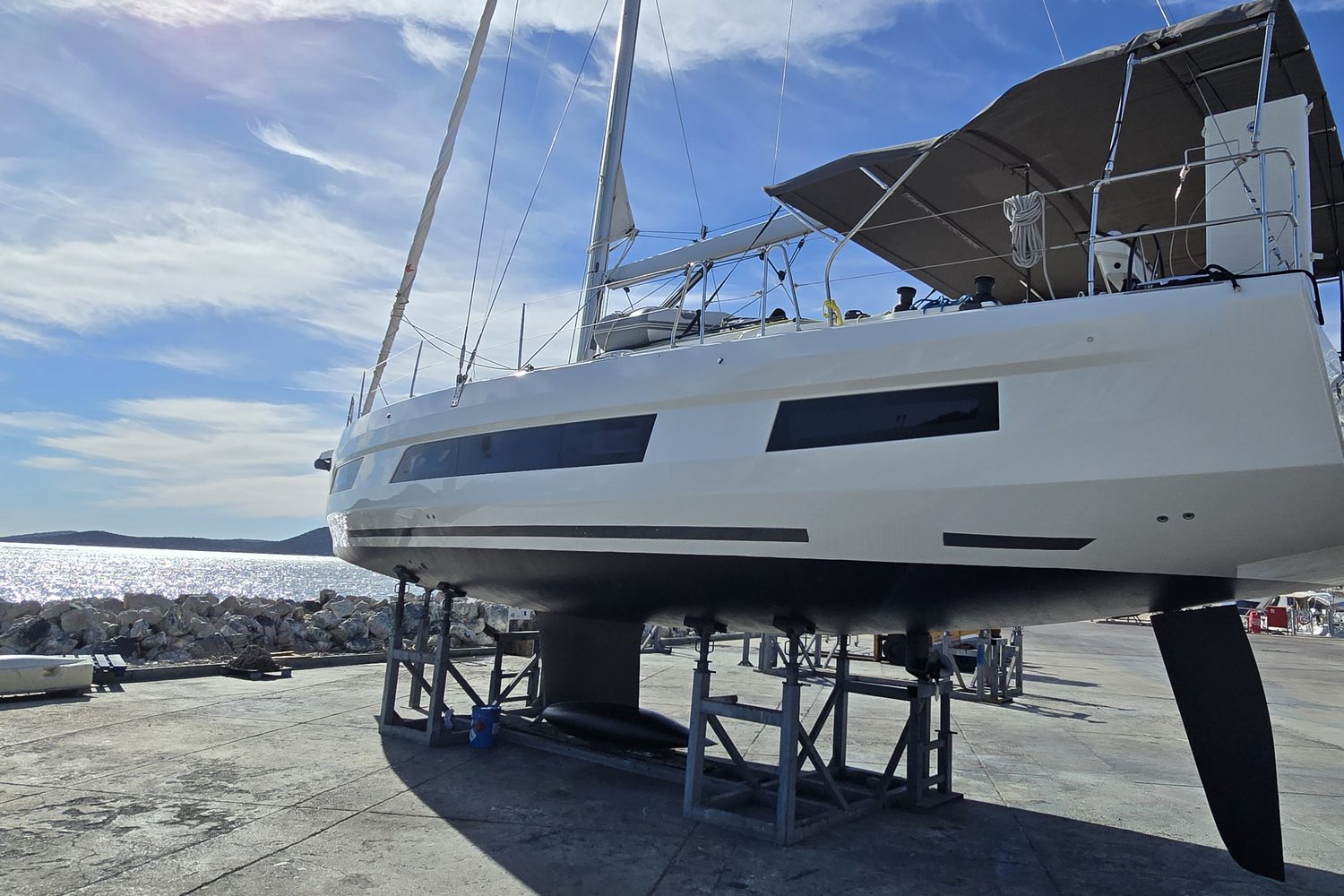
Due every year. Materials (antifouling paint): €250–450 depending on boat size and product. Labour (if you do not do it yourself): €400–700. On top: cleaning the underwater hull, checking the zinc anodes and changing them if needed (€50–100). Typically around €600–1,000 a year.
Engine maintenance (auxiliary engine)
Sailing boats as a rule have an inboard diesel as an auxiliary engine (20–50 hp). Due every year: oil change, impeller, fuel filter, checking the V-belt, zinc anodes on the saildrive. Materials: €100–250. Specialist yard: an additional €200–400. If you do it yourself, you save the labour. Typically around €300–500/year.
Rig check and sail care
The rig is the cost item that sailing boats have and motorboats do not. Every year:
Visual check of the rig: Shrouds, stays, terminals, fittings, roller furling, spreaders. You can do this yourself, but a trained eye every 5–7 years is worth it (professional check with the mast unstepped or a climb up it: €500–700).
Sail care: Washing the sails, checking the UV protection, inspecting the seams. Treated properly, sails last 8–12 years. Repairs (seam, patch): €100–300 a season, if needed.
Annual cost of rig and sails: Approx. €300–700 in a normal year (without major damage).
Winter storage
Croatia: Many boats winter in the water. The winter berth is already included in the table above; it is part of the annual berth and not an additional item. If you want to winter ashore instead, you pay €1,500–2,900 a year for lifting out and storage on top of the annual contract, but that is better for the underwater hull.
Germany / Baltic: Wintering ashore is standard. Lifting out and back in (autumn and spring), hard standing, cover: €1,000–2,700 depending on the boatyard and region. Unstepping and stepping the mast come on top: €200–500.
Lake Constance: Much as on the Baltic, winter storage ashore is usual. €900–2,000 including the crane.
Minor repairs and other items
There is always something: seals, pumps, fittings, lighting, leaks around the deck fittings. Budget: the values from the tables further down, so €1,000–2,000 for a 12.5 m boat in Croatia and €500–1,000 for a 10 m boat on inland waters. Nothing in some years, more in others.
4. The long-term items: what comes every 5–15 years
The annual costs are only part of the truth. Sailing boats have cyclical major items that do not come up every year but add up over 10–15 years. If you do not know about them, you are in for a nasty surprise.
| Item | Interval | Cost (approx.) |
|---|---|---|
| Replacing the standing rigging (shrouds, stays) | every 10–15 years | €3,000–6,000 |
| New sails (mainsail and genoa/jib) | every 8–12 years | €4,000–8,000 |
| Overhauling the roller furling | every 8–12 years | €800–1,500 |
| Osmosis treatment (on boats of glass-reinforced plastic, GRP) | once / as needed | €3,000–8,000 |
| Saildrive overhaul | every 5–8 years | €1,500–3,000 |
| Engine overhaul (auxiliary engine) | after approx. 3,000–5,000 engine hours | €2,000–4,000 |
| Electronics upgrade (plotter, radar, automatic identification system AIS) | every 8–12 years | €2,000–5,000 |
| Renewing upholstery (cockpit and saloon) | every 10–15 years | €3,000–7,000 |
Source: guide values from market research.
The rule of thumb among experienced owners: plan a yearly reserve of 10–15% of annual running costs for these major items. At €12,500 annual costs that is €1,250–1,875 a year; after 10 years you have €12,500–18,750 in reserve, which covers most individual major items.
In co-ownership this reserve is set in the Living Contract (co-owner agreement) and split between all owners by share. Instead of finding €6,000 alone for re-rigging, with a quarter share you pay €1,500, and the decision is taken together.
5. Six features that show you the running costs before buying
The table of long-term items says what an item costs. It does not say where the boat you want stands on each item right now. On a motorboat a single feature shows this, the drive (Motorboat running costs). On a sailing boat there is no such single point: six features count here, and each falls due in its own time.
| Feature | Why it determines the running costs | What you ask the seller |
|---|---|---|
| Standing rigging | The only item with a recognised upper limit. Besides the interval above there is a mileage limit of around 20,000 nautical miles, and some insurers set it shorter in the policy | Year the standing rigging was fitted, proof available? |
| Sails and roller furling | Roller furling leaves the cloth permanently in the sun. Laminate sails are finished after around 3 sailing seasons in the Mediterranean; well-kept polyester cloth lasts many times that | Type of cloth, age, furled or stowed? |
| Drive: saildrive or shaft | The saildrive diaphragm seal is a manufacturer’s requirement with a fixed due date, approx. every 7 years, and needs the boat ashore. The shaft seal comes approx. every 5–10 years, depending on the type | Date of the last diaphragm change? |
| Hull: osmosis history | Stripping the underwater hull is a yard job, not a maintenance item. The risk rises from about 10 years onwards | Survey available, already treated? |
| Deck: teak or GRP | Teak is on a countdown, GRP is not. Re-laying is due after around 35 years, refurbishment considerably earlier | Age of the deck, how often already sanded down? |
| Engine: cooling circuit and engine hours | An engine with indirect (freshwater) cooling lasts considerably longer than one with direct (raw-water) cooling | Engine hours, type of cooling, service records? |
The intervals for the drive, the standing rigging, sailcloth and teak are third-party manufacturer and market figures, not PartABoat figures. Sources: yacht.de (26 October 2025) and boat24 (7 July 2026), accessed on 14 September 2026; for shaft seal and saildrive diaphragm, the operating manuals of two engine manufacturers (2009 and 2013) and the figures of a seal manufacturer, accessed on 13 October 2026.
This gives the practical rule for every viewing: Don’t ask about the condition, ask for the date. “All in order” is not an answer; “Rig 2019, here’s the invoice” is.
6. Annual sums: Bavaria Cruiser 41, built 2015, Croatia
| Type of cost | approx. per year |
|---|---|
| Berth (annual berth, including winter berth) | €5,500–11,000 |
| Insurance (third-party liability and hull) | €800–1,500 |
| Antifouling and underwater hull | €600–1,000 |
| Engine maintenance (auxiliary engine) | €300–500 |
| Rig check and sail care | €300–700 |
| Minor repairs, other | €1,000–2,000 |
| Total (excluding fuel and major items) | approx. €8,500–16,700 |
| Rule of thumb (€1,000 × 12.5 m) | approx. €12,500 |
Source of the items and of the rule of thumb: guide values from market research (chapter 1).
Note: A recurring seaworthiness certificate is not included in this list. Whether one applies to your boat depends on flag and cruising area and should be cleared up before buying.
The rule of thumb lies in the middle of the breakdown; if your berth is in an expensive marina, you will come in above it. In good years you are below it, in years with a rig repair or saildrive service above it.
As a quarter owner you pay around €3,125/year, instead of €12,500 as a sole owner.
7. Annual sums: 10 m sailing boat, Germany inland
For comparison: a smaller sailing boat (10 m, for example a Bavaria 33 or Dehler 34) on German inland waters.
| Type of cost | approx. per year |
|---|---|
| Berth (annual berth, harbour run by a boating association/ |
€1,200–2,500 |
| Insurance (third-party liability and hull) | €400–800 |
| Antifouling and underwater hull | €400–700 |
| Engine maintenance (auxiliary engine) | €200–350 |
| Rig check and sail care | €200–500 |
| Winter storage (ashore, including crane and mast) | €1,000–1,700 |
| Minor repairs, other | €500–1,000 |
| Total (excluding fuel and major items) | approx. €3,900–7,550 |
| Rule of thumb (€600 × 10 m) | approx. €6,000 |
Source of the items and of the rule of thumb: guide values from market research (chapter 1).
That is considerably cheaper than in Croatia, mainly because berth and insurance cost less. The rule of thumb of €600/m/year sits well in the middle of the range here.
As a quarter owner you pay around €1,500/year, instead of €6,000 as a sole owner.

8. Costs by cruising area: Croatia, Baltic, Lake Constance, inland
Where you keep your boat has a strong effect on the total cost. Here is a comparison for a sailing boat 12–13 m long:
| Cruising area | Running costs approx. / year | Biggest cost driver |
|---|---|---|
| Croatia (Adriatic) | €10,000–14,000 | Berth and travel there |
| Baltic | €8,000–12,000 | Winter storage (ashore is standard) |
| Lake Constance | €9,000–13,000 | Berth (scarce and expensive) |
| Germany inland | €6,000–8,000 | Cheapest overall |
| Côte d’Azur / Balearics | €18,000–30,000+ | Berth (extreme) |
Source: estimated ranges from market research, not calculated from individual items.
Croatia offers 1,000 islands, clear water and good infrastructure and still costs less than the western Mediterranean. But then there is the journey there (flights, hire car), and that is not in the rule of thumb. If you keep your boat on the Baltic or on Lake Constance, you pay less in running costs and save the journey, but you sail in a different cruising area.
German inland waters are the cheapest (Rhine, Moselle, Mecklenburg Lakes), though the choice of cruising areas is smaller. If you mainly sail at weekends and do not need a cruising area for long trips, you do best there.
9. What co-ownership (fractional ownership) changes in the sums
The running costs of a sailing boat do not change through co-ownership; a boat costs what it costs. What changes is your share of them.
So that this also holds with people you did not know before, things happen in a set order: you get to know each other and set down in the Living Contract (co-owner agreement) who sails when, who pays what and how someone leaves again, before ownership is transferred. Your share belongs to you; it is not a membership.
| Bavaria Cruiser 41, Croatia | Sole owner | ½ share | ¼ share |
|---|---|---|---|
| Running costs / year | approx. €12,500 | approx. €6,250 | approx. €3,125 |
| Major repair (for example rig €6,000) | €6,000 | €3,000 | €1,500 |
| Weeks of use / year | on paper 50, in practice 4–6 | on paper 25 | on paper 12 |
Source of the amounts: rule of thumb from chapter 1 and re-rigging from chapter 4, divided by share.
On paper means: the share of 50 usable weeks a year; a quarter gives 12 weeks. How you divide them, you set in the Living Contract. In practice: that is how many weeks a sole owner typically uses their boat.
€3,125 a year for a 12.5 m sailing boat in Croatia. With that amount, a boat of your own comes within reach.
And when a major repair comes up: €1,500 instead of €6,000. The decision is easier when everyone bears only their part.
How that comes about among sailors: Co-owner group for a sailing boat
The full calculation over 5 years, with charter alongside: For buyers
Work it out yourself: Charter vs. share: cost calculator
10. Frequently asked questions
What does a sailing boat cost per month?
The annual running costs are the better measure, because expenses such as antifouling, insurance and the rig check fall unevenly over the year. As a sole owner you pay around €12,500 a year for a 12.5 m boat in Croatia, around €6,000–8,000 for a 10 m boat on the Baltic and around €6,000 on inland waters. With a quarter share you pay a quarter of that in each case.
Is a sailing boat cheaper than a motorboat?
In running costs: yes, clearly. The rule of thumb is €1,000/m (sail, Croatia) against €1,500/m (motor, Croatia), about a third less. The main difference: lower fuel consumption, cheaper insurance, a simpler auxiliary engine. The sailing boat, on the other hand, has the rig as an additional cost item. The details for motorboats are in Motorboat running costs.
What does re-rigging cost?
Standing rigging (shrouds, stays) for a 12.5 m boat: around €3,000–6,000 including materials and labour. Interval: every 10–15 years, depending on material (wire or rod) and use. Some owners replace it as a precaution after 12 years, others have it checked every year and act on what is found.
How do I recognise osmosis?
Osmosis shows up as blistering under the gelcoat on the underwater hull. The best time to check is at the yearly antifouling coat: if blisters form or the gelcoat goes soft, a moisture reading is due. Treatment: €3,000–8,000 depending on severity. Modern GRP boats (from around 2000 onwards) are considerably less prone to it.
Can I do the maintenance myself?
Much of it, yes: antifouling, oil changes, sail care, cleaning, polishing, changing zinc anodes. Rig work and engine overhauls belong in expert hands. In co-ownership, looking after the boat together is an advantage: one has technical experience, the other the patience for the GRP, and together the boat is looked after faster and better than alone.
Do the costs fall as the boat gets older?
Partly. The hull insurance premium falls with the insured value. In exchange, repairs are needed more often, and seals, electrics and upholstery need more care. From around 15–20 years this evens out: annual costs stay relatively stable as long as the boat is well looked after. What does not stay stable are the long-term items from chapter 4: they are not in the rule of thumb and fall due with age.
Conclusion
Everyone knows a sailing boat costs money. If you know the figures beforehand, you decide more wisely and get no nasty surprise afterwards. Annual costs come to €6,000–12,500 depending on boat and cruising area. The long-term items (rig, sails, osmosis) come on top, but can be absorbed with an annual reserve.
With a quarter share you pay €3,125 a year for a 12.5 m boat in Croatia or €1,500 for a 10 m boat on an inland lake. Your share really belongs to you, you know every cost item, and you split the reserve for major repairs by share.
View all boats Try the cost calculator Boat chat Sell your boat or bring co-owners on board All guides
About the author: Ekki is the founder of PartABoat and a co-owner of two motorboats. The cost figures for sailing boats in this article are based on market research and the rules of thumb we use at PartABoat. All figures are guide values, not a promise.
Related articles
- Co-owner group for a sailing boat: get to know each other first, then buy
- What a boat really costs: the honest calculation
- Motorboat running costs: what drive and age really cost
- Fractional boat ownership: the complete guide
- Charter vs. share: when does buying pay off?
- Share your boat instead of selling: a guide for owners