
Share your boat instead of selling: a guide for owners
Reading time: about 18 minutes · By Ekki, co-owner of two motor boats
You do not want to give up your boat. You are attached to it: to the memories, to the berth, to the feeling when you step aboard in the morning and cast off.
Your boat lies in the harbour. You are out on it for four, five, perhaps six weeks. The rest of the time it sits idle, and the work stays with you.
Selling feels wrong, but so does carrying it all alone. This article shows you the third way: you bring co-owners on board instead of giving everything up. With specific figures, a clear process and a contract that sets down binding rules for everyone.
This guide was written for owners and buyers in Germany. Legal, tax and boat-paper points refer to German law and practice; other countries may differ.
1. Why so many boats are for sale and still nobody buys
 Thousands of boats are on the usual boat marketplaces, many of them for months. Especially in the sailing market it has long been a buyer’s market: supply exceeds demand, prices are under pressure, and brokers can do little when there are simply too few interested people willing to pay €100,000 or €200,000 in one go for a used boat.
That is not because nobody wants to go boating. For a whole boat you are looking for a buyer who wants exactly this boat, in the right cruising area, and who can raise the whole price at once. The bigger and more expensive the boat, the smaller this circle becomes.
The consequence for you as an owner: your boat sits on a platform with thousands of other boats. The price falls, the time on the market grows, and the one buyer does not come.
With shares you reach different buyers: people who want exactly this kind of boat and would rather own it between two, three or four people. €25,000 for a quarter of a Bavaria Cruiser 41 or €57,500 for a quarter of a Prestige 42: for an amount like that there are considerably more people interested in a boat than for the full purchase price.
This is where fractional co-ownership comes in: if the one buyer is missing, up to four can take their place.
2. The third option: bring co-owners on board instead of giving everything up
Fractional co-ownership means: you sell one or more shares in your boat, in quarters: a quarter, a half or three quarters. Every purchase is documented by the purchase contract and handover record. That you are the owner is shown by the documents on your own acquisition; you hand these over to the buyers, as far as you have them. Not hire, but real ownership under the German Civil Code (BGB), §§ 741 ff.
You may know “we’ll buy a boat together” on a handshake from people you know. The difference is firm rules. At PartABoat, the Living Contract (co-owner agreement) is part of every purchase of a share: a contract that settles how costs are split, the reserves for repairs and how to leave, and in which you set the usage times together. What clean means, who cleans what and how the boat is handed over, you set down in writing before buying. Not because co-owners argue for no reason, but because there is less to argue about with clear rules.
Important: at PartABoat it remains a small, fixed co-owner group of up to four co-owners. This is a deliberate choice. With more than four owners the weeks of use become too few, the personal bond with the boat is lost, and the whole thing feels like charter, only more complicated. Four is the limit up to which ownership still feels like ownership.
What that means for you as an owner: you are not selling to anonymous financial buyers or a management company. You get to know your co-owners beforehand, in person, before anybody signs a contract. As soon as PartABoat accompanies the purchase, it organises these introductions. Until then, on request, we put you in touch with the interested parties. When selling your shares, you stay in control at every step of who comes onto your boat.
3. Three scenarios: which one suits you?
Not every owner wants the same thing. Three routes are open to you:
Scenario A: You keep the boat, and the work is shared
You bring one to three co-owners on board and keep the rest. You carry on using the boat, just a few weeks less, and the work is shared. Where it lies, you decide together. Ask your harbour first: some accept only one contract partner or no co-owner group. Your name stays in the papers, your boat stays your boat.
That is what selling a share is about: you gain co-owners who look after and use the boat with you, instead of it lying in the harbour for months.
Scenario B: You want to sell outright but cannot find a buyer
Your boat has been on the usual platforms for months. The broker has cut the price, you have cut the price, but the buyer for the whole boat does not come. Through PartABoat you can sell your boat outright: up to four buyers take it over together, each with a share.
You keep no share and are completely out.
Scenario C: You sell and size up
You sell your boat as a whole, to up to four buyers. With the proceeds you buy a share in a bigger boat. These are two separate purchases; you look for the bigger one while your boat is listed.

4. Worked example, sailing yacht: Bavaria Cruiser 41, built 2015, Croatia
Rule of thumb for sail: €1,000 per metre per year (Croatia/Adriatic), a guide value from market research. Bavaria Cruiser 41, approx. 12.5 m, market value approx. €100,000.
| Bavaria Cruiser 41, built 2015 | You alone | You keep ½ | You keep ¼ |
|---|---|---|---|
| Sale proceeds | – | approx. €50,000 | approx. €75,000 |
| Your running costs / year | approx. €12,500 | approx. €6,250 | approx. €3,125 |
| Your weeks of use | unlimited (in practice 4–6) | 25 (on paper) | 12 (on paper) |
| Cost reduction | – | approx. 50% | approx. 75% |
The costs in the co-ownership columns follow the Living Contract; the weeks are calculated.
With a sailing yacht it looks like this: at completion you receive €50,000, your running costs halve, and on paper you keep 25 weeks a year. If your boat has been on the market for months and you do not want to give it up completely, that is an alternative to waiting for the one buyer of the whole boat.
A worked example for Scenario B, the whole-boat sale: four buyers each pay €25,000 for a quarter, €100,000 together. You negotiate the price with the buyers.
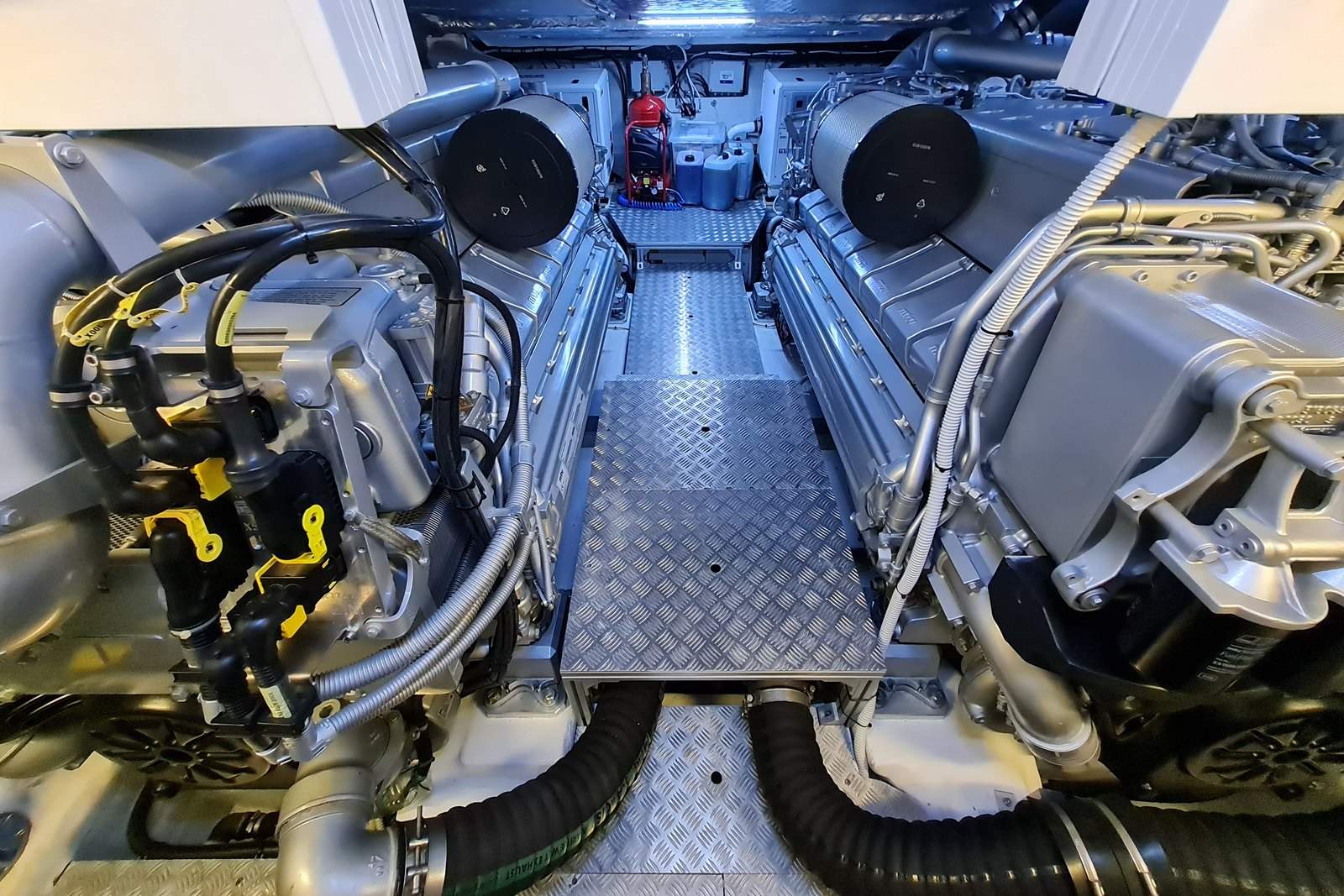
5. Worked example, motorboat: Prestige 42, built 2010, Croatia
All figures are based on the rule of thumb of €1,500 per metre per year (motorboat, Croatia/Adriatic) and the current market price of a Prestige 42 (built 2010, approx. 13 m).
| Prestige 42, built 2010 | You alone | You keep ½ | You keep ¼ |
|---|---|---|---|
| Sale proceeds | – | approx. €115,000 | approx. €172,500 |
| Your running costs / year | approx. €19,500 | approx. €9,750 | approx. €4,875 |
| Your weeks of use | unlimited (in practice 4–6) | 25 (on paper) | 12 (on paper) |
| Cost reduction | – | approx. 50% | approx. 75% |
The costs in the co-ownership columns follow the Living Contract; the weeks are calculated.
In concrete terms: you sell two quarter shares in your Prestige 42 and receive approx. €115,000 in your account. Your annual running costs halve to approx. €9,750. On paper your half still comes to 25 weeks a year and, if you set July and August as the high season at sea, 4 weeks within it; how you allocate the weeks, you set together in the Living Contract. On inland waters, our template allocates the high season in weekends.
On top of that you have two co-owners who help with care and maintenance, share the costs and move the boat regularly. A boat that gets used suffers less damage from standing idle than one that sits still for months. That does the engine, hull and onboard systems good.
What if you realistically use it only 6 weeks a year? Then even a quarter share with 12 weeks on paper changes nothing about your actual use, but your costs fall by up to 75%.
6. What the Living Contract settles
The Living Contract is the backbone of every co-owner group at PartABoat. It sets down what has to be clear between co-owners before questions or disputes arise: some things the PartABoat template prescribes, others you set together. The most important points:
- Usage plan: Who is out on the boat when? You set the usage plan together in the Living Contract, and after that it can be changed only unanimously. On paper a quarter share comes to 12 weeks a year, not the real use.
- High season: The PartABoat template of the Living Contract divides the high season by your shares and rotates every year, on a fixed rotation, who gets which weeks. You decide together which weeks count as high season; with July and August, at sea each owner is entitled to at least 2 weeks under our template. No lottery, no first come, first served.
- Cost allocation: All running costs are split by share: berth, insurance, maintenance, winter storage. The Living Contract defines which costs are borne jointly and which (fuel, for example) depend on use.
- Reserves: Every year you adopt a budget and put money into a joint reserve for maintenance and replacement. You decide day-to-day matters by a majority counted by shares; in a tie, a proposal is rejected. Larger spending that is not needed to maintain the boat and costs more than a quarter of the budget needs three quarters of the shares and a majority of you by heads; if no decision is reached, an expert decides at the request of one of you. You pay for larger costs from the reserve and by share.
- Standards of care: What clean means, who cleans what and how the boat is handed over, you set down in writing before buying, and after each use the logbook records damage and anything unusual. This protects you as the previous sole owner from your boat suffering in several pairs of hands.
- Leaving: Every co-owner can sell their share at any time, through the PartABoat marketplace or privately; there is no minimum period of ownership for selling. If no buyer is found, dissolving the co-ownership can be demanded in the first three years only for good cause, after that with six months’ notice expiring on 31 October. And as a remaining owner you have rights before anyone new arrives: you must be notified of every sale beforehand, and you can reject a successor for good cause relating to that person, for example if facts suggest they will seriously or repeatedly breach the rules on use and costs. You must do so within 30 calendar days of the notice, otherwise your consent counts as given; if you ask for further details about the person within seven calendar days, this period is suspended until you receive them, for at most 14 calendar days.
- Right to buy: The PartABoat template provides for a right to buy among the co-owners: if a co-owner has a buyer for their share, they notify the others of the sale, naming the buyer, the price and the terms, and from receipt of this notice you have 30 calendar days to take over their share yourself at that price and on the terms of their contract. They conclude the contract with their buyer only once you have consented and have not taken over the share yourselves, or subject to that condition. You can buy the share back and enlarge your own share again, or accept the new co-owner.
Good to know: The Living Contract is a template under German law (BGB §§ 741 ff.). What we describe here is what the template provides for. What is settled in the co-owner agreement we show you in advance in an overview, question by question. In a whole-boat sale the group of buyers receives the full contract; it discusses it at the group meeting and adapts it in individual places to its co-owner group.
7. The process: step by step
As an owner you go through four steps at PartABoat. At every step you stay in control, and until you are bound to a group of buyers you can stop at any time.
Step 1: Create a listing
You create a listing with photos, boat details, your price expectation and the share structure you want. You choose: in a sale of a share you remain a co-owner. In a whole-boat sale you leave altogether. PartABoat looks at the listing before publishing it and then publishes it; PartABoat does not verify the information in it, nor the boat itself. Cost: none. You can still list your boat on other platforms too. Until you are bound to a group of buyers, you can also sell the boat outright at any time.
Step 2: Check & get to know each other
Buyers arrange a viewing on site, with a sea trial or test sail and a technical inspection. You negotiate the price of the share. PartABoat provides a checklist for buying a boat and puts you in touch. As soon as PartABoat accompanies the purchase, it then organises introductions for all the prospective co-owners: a video call or a meeting on site. You are there. Only when you and the others involved agree does it go further. Duration: we expect 4–8 weeks.
Step 3: Confirm the buyers
In a sale of a share the buyer decides directly, with no intermediate step.
In a whole-boat sale: nothing becomes firm until the buyers’ shares together make up the whole boat and you have confirmed the group. With your confirmation you make the group your offer; the buyers accept it in text form within 5 working days and pay you nothing towards the purchase price before the handover. The option fee, staggered by size of share (€750 for a quarter, €1,000 for a third, €1,500 for a half, €2,250 for three quarters, each at most 10% of the share of the purchase price), is their price for you committing the boat to this group alone for 45 days. A buyer owes it to you only if they do not buy in the end, and then pays it when the option period ends, directly to you and not to PartABoat. Once your offer has reached the buyers, the purchase price is fixed, and you are bound; the option period begins once all have accepted and lasts 45 days, longer only if a replacement procedure runs after a buyer drops out (at most 23 days more). If no complete group of buyers comes together, nobody pays an option fee: no risk for the buyers, no purchase contract for you.
Commission, structuring fee and option fee are final prices. Any statutory VAT and other price components are contained in them.
Step 4: Complete the sale
The purchase contract and Living Contract are signed. Only then do the buyers pay the purchase price, on the handover date directly to you, once keys and papers have been handed over. The purchase price never goes to PartABoat. The purchase is documented by the purchase contract and handover record. You have set the usage plan together, the costs are split. Your co-owner group begins.
PartABoat is just starting: listing and enquiries already work. Until PartABoat accompanies the purchase, you buy directly; you then organise getting to know each other and forming the group yourselves. How to secure the purchase price is set out in the information sheet.
What does PartABoat cost you?
5.5% commission on the value of the share, at least €350 per buyer, only on a successful sale. If you create a listing by 28 February 2027, you pay no commission for that listing, provided the purchase contract is concluded by 31 December 2027 (terms of the offer). No listing fee, no monthly costs. If no sale comes about, you pay nothing, even if you reject a group of buyers. If, however, you prevent the purchase in bad faith, for example by selling the boat to someone else while you are bound, you owe the commission that would have arisen on a purchase by the group (so none under the introductory offer) and the loss this causes us. PartABoat is paid by both sides: you pay the commission, and each buyer of a share pays a one-off structuring fee; anyone buying the whole boat alone pays none. Both fall due only after completion, the commission for a buyer without a service agreement with PartABoat already after the purchase contract.
More details on the process: How it works: the whole process
8. Objections and answers
“It never worked with people I know.”
That does happen. Shared boats fail, and almost always over the same five things: cleanliness, the high season, damage, leaving and money. Whether it works depends on the people and on what has been settled in advance. What you set down on each topic before buying is covered in Why shared boats fail.
“I will lose control of my boat.”
We hear this objection on the pontoon again and again, and it is the most understandable one. You have looked after your boat alone for years, you know every scratch, you know exactly how it sounds when everything is right.
The answer: you remain an owner and share in the decisions, and your co-owners are bound by the same rules as you. What clean means, who cleans what and how the boat is handed over, you set down in writing before buying. You get to know the buyers of your shares in person before any contract is concluded, and you decide who you sell to. If a co-owner later leaves, the PartABoat template provides for a right to buy among the co-owners: you can take over their share at the price their buyer would pay, or reject the buyer for good cause relating to that person.
“Is it worth it with my boat?”
In principle yes, because you split the running costs by share. That applies to a €20,000 boat just as to a €200,000 boat: berth, insurance and maintenance keep running, whatever you paid.
The only real limitation is condition: boats in poor condition put co-owners off; nobody spends money on a share if high repair costs are foreseeable. A boat that stands up to a viewing and has a traceable maintenance history is a good candidate.
“I actually want to sell outright.”
That works at PartABoat too. You list your boat with all four shares. Until you are bound to a group of buyers, you can also sell the boat outright at any time. If no single buyer comes along, a group of buyers can take over the four shares. The purchase price is then spread across several shoulders instead of one.
“What if no co-owner can be found?”
Then nothing happens. Your boat stays your boat, you pay nothing to PartABoat, and you can delete the listing at any time. There is no minimum term and no listing fee; as long as no binding group comes together, you carry no cost risk. If not enough buyers are found, there is no purchase contract, and you are not bound to anything.
“What will my neighbours on the pontoon think?”
Sharing boats is nothing new, among friends or in the family often on a handshake. At PartABoat a contract and clear rules are added. The difference is not whether you share, but how.
9. Frequently asked questions
What does PartABoat cost me as an owner?
The amounts are in chapter 7. If you create a listing by 28 February 2027, you pay no commission for that listing, provided the purchase contract is concluded by 31 December 2027 (terms of the offer). No listing fee, no monthly costs. If no sale comes about, you pay nothing, even if you reject a group of buyers. Each buyer of a share also pays PartABoat a one-off structuring fee; anyone buying the whole boat alone pays none.
How long does it take to find co-owners?
That depends on the boat, price and cruising area; we do not yet have figures based on experience. Until you commit to a group of buyers, you carry on using your boat and may offer it elsewhere in parallel.
Can I list my boat on other platforms at the same time?
Yes. Listing in parallel is allowed. Until you are bound to a group of buyers, you can also sell the boat outright at any time.
Who looks after repairs and care?
The Living Contract settles this. Day-to-day care lies with the owners; one co-owner is contact person for a year at a time, obtains quotes and prepares your resolutions, and the role rotates in turn. One of you, as contract holder, concludes the contracts for the berth, the yard, winter storage and insurance for all of you; the joint account is in all your names. You decide on larger repairs under the rules in chapter 6 and pay for them by share. An annual reserve cushions unplanned costs.
What if a co-owner does not pay?
The Living Contract settles payment duties and the consequences of late payment; there is no contractual penalty. If a co-owner does not pay despite a reminder and a reasonable further period, the rest of you can step in and pay for them and demand reimbursement from them. If, after a reminder that points out this consequence, they are more than two monthly contributions in arrears, their usage times are suspended until they pay; these do not lapse but are made up to them later, as far as the others’ usage times allow. Once they are more than two annual contributions in arrears, the rest of you can take over their share at its full value and set the arrears off against the price.
Can I recommend my boat to someone I know who wants to become a co-owner?
Yes. If you already know someone who would like to buy a share, that person can respond directly to your listing. PartABoat provides the template documents and supports the process; you bring the co-owners.
Conclusion
Giving up a boat entirely is not the only way. Waiting for months on the usual platforms, cutting the price and in the end selling below value makes nobody happy.
Selling shares is not an emergency solution. It is a decision: you keep your boat, gain co-owners who look after and use it with you, and bear your share of the costs. Or you sell outright, to up to four buyers together, instead of to the one buyer who may never exist.
Either way: your boat gets a second life. It gets used instead of standing still.
Create a listing Fancy a boat chat? How it works for owners All guides
About the author: Ekki is the founder of PartABoat and a co-owner of two motorboats, one in Croatia, the other on the Rhine. Together with his friend he has used five boats over the years. Along the way he has seen that shared ownership works when the rules are right, and that is why PartABoat exists.