
Motorboat running costs: what drive and age really cost
Reading time: about 13 minutes
What does a motorboat cost per year? Most of the sums you will find stop at the same point: berth, insurance, maintenance, done. What is missing are two questions on which a lot of money depends in real boating life: which drive sits under your boat and when the cyclical items last fell due.
This article includes both in the sums. It also answers the question nearly everyone interested in a boat asks at some point: Isn’t it cheaper to buy an older boat alone than to share a newer one with others? The answer can be worked out, and it is not the one you expect.
The rules of thumb come from our own experience with two motorboats, one in Croatia and one on the Rhine. The figures for the drives in chapters 4 and 5 are manufacturer and market figures with sources, the other values come from market research. All figures are guide values, not a promise.
1. The rule of thumb, and what it covers
The rule of thumb we use at PartABoat works from length:
Annual running costs = boat length (in metres) × cost factor per metre
| Cruising area | Motorboat |
|---|---|
| Croatia / Adriatic | approx. €1,500/m/year |
| Germany / inland | approx. €800–1,000/m/year |
Source: our own experience with two motorboats, one in Croatia and one on the Rhine.
This includes berth, insurance, routine maintenance (antifouling, engine service) and minor repairs, plus winter storage ashore in Germany. It does not include fuel or the cyclical major items, meaning engine overhaul, drive overhaul, osmosis treatment and upgrades. For those there is a separate reserve of 10–15% of annual costs, so around €2,000–3,000 a year for the Prestige 42.
The rule of thumb assumes a harbour and a workshop. Small boats and a lot of your own work come in below it.
In concrete terms: a Prestige 42 (approx. 13 m, built 2010, Croatia) costs around €19,500 a year. A Bavaria 37 (approx. 11 m, motorboat) costs around €16,500 in Croatia and around €9,000–11,000 on German inland waters.
2. What the purchase price does not tell you
Read the formula above again. It contains no purchase price. Running costs depend on length, not on what you paid for the boat. Two motorboats of the same length in the same cruising area cost roughly the same per year, even if one was three times as expensive as the other.
This is no sleight of hand; it follows from the items themselves: berth, lifting out, winter storage and antifouling are charged by length and area. Only the hull insurance premium depends on value, and that falls with age anyway. So if you buy cheaper, you pay less for the boat, but not less in running costs.
Age changes something else: when the cyclical major items fall due. On a boat from 2000 with its original drive, more of them are due than on one from 2015. Both pay the same berth; when the yard comes into it is shown in the previous owner’s invoices.
The sums for this, with our reference boats and a typical cheap used boat, a 12 m motorboat built in 2000 for around €20,000:
| ¼ share in a Prestige 42, built 2010 | Alone: 12 m boat, built 2000 | |
|---|---|---|
| Upfront costs | approx. €57,500 | approx. €20,000 |
| Running costs per year | approx. €5,000 | approx. €18,000 |
| Total after 5 years | approx. €82,500 | approx. €110,000 |
Source: running costs from the rule of thumb in chapter 1; purchase price of the Prestige 42 from market research, the boat from 2000 is a worked example.
Not included are fuel, incidental purchase costs and the residual value after five years. The cheaper boat costs more within five years, and neither column contains a single major item. On the boat from 2000, considerably more of them are due.
This expressly does not mean that older or cheaper boats are not worth it. A well-kept boat from 2000 can be an excellent buy. It only means that the purchase price says little about what the boat costs you per year.
3. All cost items in detail
Berth
The largest single item in most cruising areas. At 12–13 m: Croatia, ACI and private marinas, including the winter afloat, €5,500–11,000; Germany inland €1,500–3,500; Baltic €1,700–3,800; Lake Constance €1,500–7,000, but hardly any to be had there. The berth does not, as a rule, pass with the boat.
Insurance
Third-party liability €150–400, hull insurance 0.5–1.5% of the boat’s value. The hull insurance premium is the only item that falls noticeably with the boat’s value.
Engine maintenance
With two diesels, €800–1,200 a year for routine servicing. What this does not include is the drive behind the engine, and that is exactly what chapter 4 is about.
Antifouling and underwater hull
Materials €250–600, labour €400–800. If you sand and roll it on yourself, you pay only for materials.
Winter storage
Standard in Germany, on the Baltic and on the North Sea, usual on Lake Constance. Motorboat of approx. 12 m ashore: €1,200–2,200. In Croatia it is mostly included in the annual berth.
Minor repairs
According to market research, unplanned repairs come to €1,000–3,000 per boat per year. Typical individual items: impeller around €200, rudder bearing €500–1,000, bow thruster repair €800–2,000.
Fuel
Not in the rule of thumb. A planing boat with two engines burns 40–60 litres an hour at cruising speed; at 100–150 engine hours a year that comes to around €6,000–9,000.
4. The drive: the item hardly anyone factors in
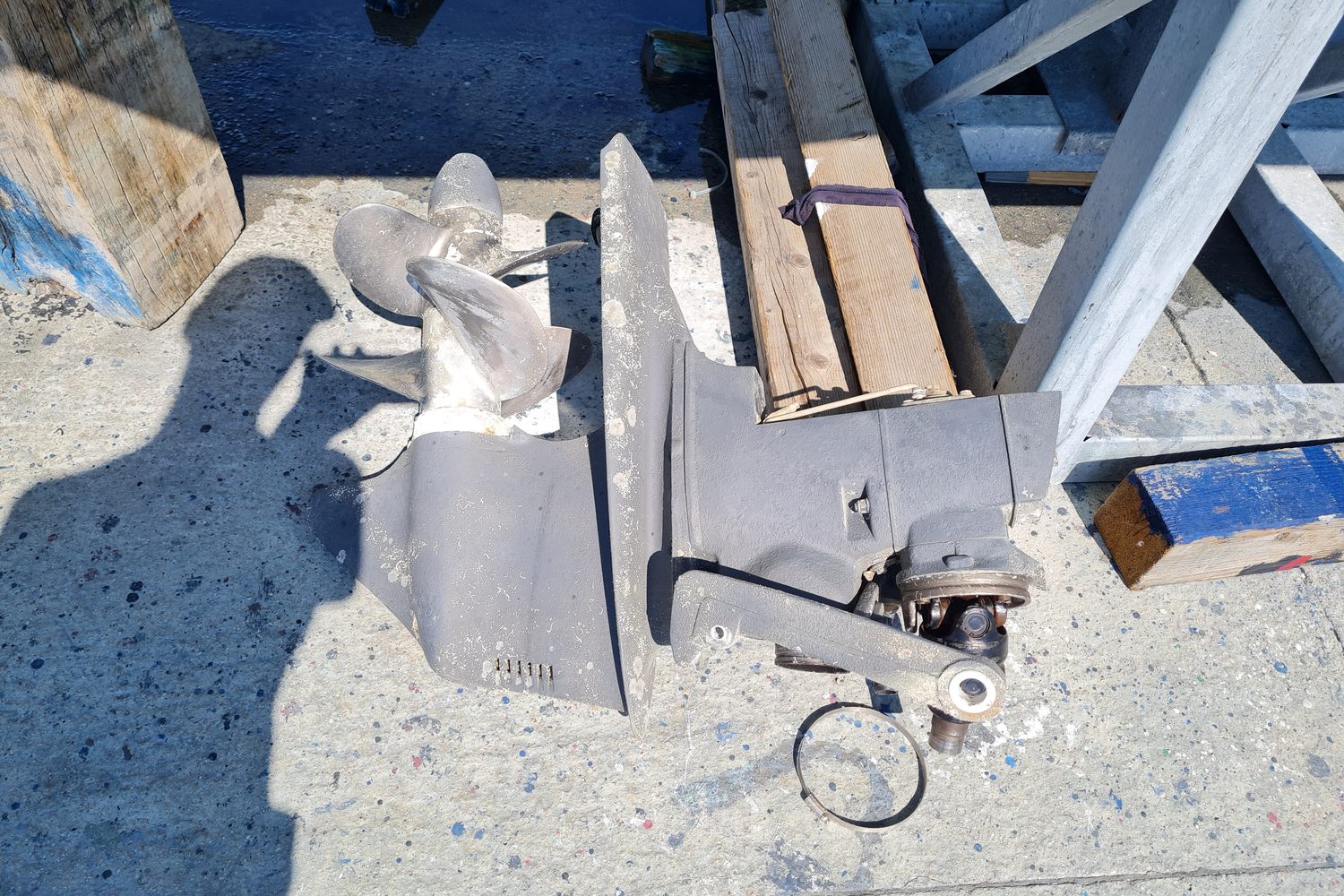
Motorboats have four types of drive, and they differ clearly in running costs. On the market you will meet them under many names: depending on the manufacturer, sterndrives are also called outdrives or Aquamatic, and pod drives go by names such as IPS or Zeus. Whatever name is on it changes nothing about the type of construction, and the type of construction is what counts.
The following intervals and amounts are manufacturer and market figures, not PartABoat figures. The sources are given below the table.
| Drive | What comes up regularly, and how often | The expensive point | Question for the seller |
|---|---|---|---|
| Shaft drive | Stern gland, shaft bearings, alignment, anodes; gland approx. every 5–10 years, depending on the type | Gearbox, shaft or P-bracket. In a damage comparison from a trade conference, the modern standard shaft installation comes to around €1,500 | When was the stern gland last done? |
| Outboard | Oil, impeller, spark plugs, anodes, freshwater flush; impeller every 200–300 engine hours | The service life itself: around 1,000–3,000 engine hours. After that the engine is the item, not the maintenance | How many engine hours, and which servicing is documented? |
| Sterndrive | Bellows, gimbal bearing, universal joints, drive oil, anodes; bellows under the manufacturer’s schedule in some cases every 2 years, usual on the market every 4–6 years, sooner in sun and salt water | The bellows change, and if gimbal bearing, universal joints or shift cable go with it, several times that. Damage to the lower unit, same source: around €2,700–3,200 | Date of the last bellows change, with invoice? |
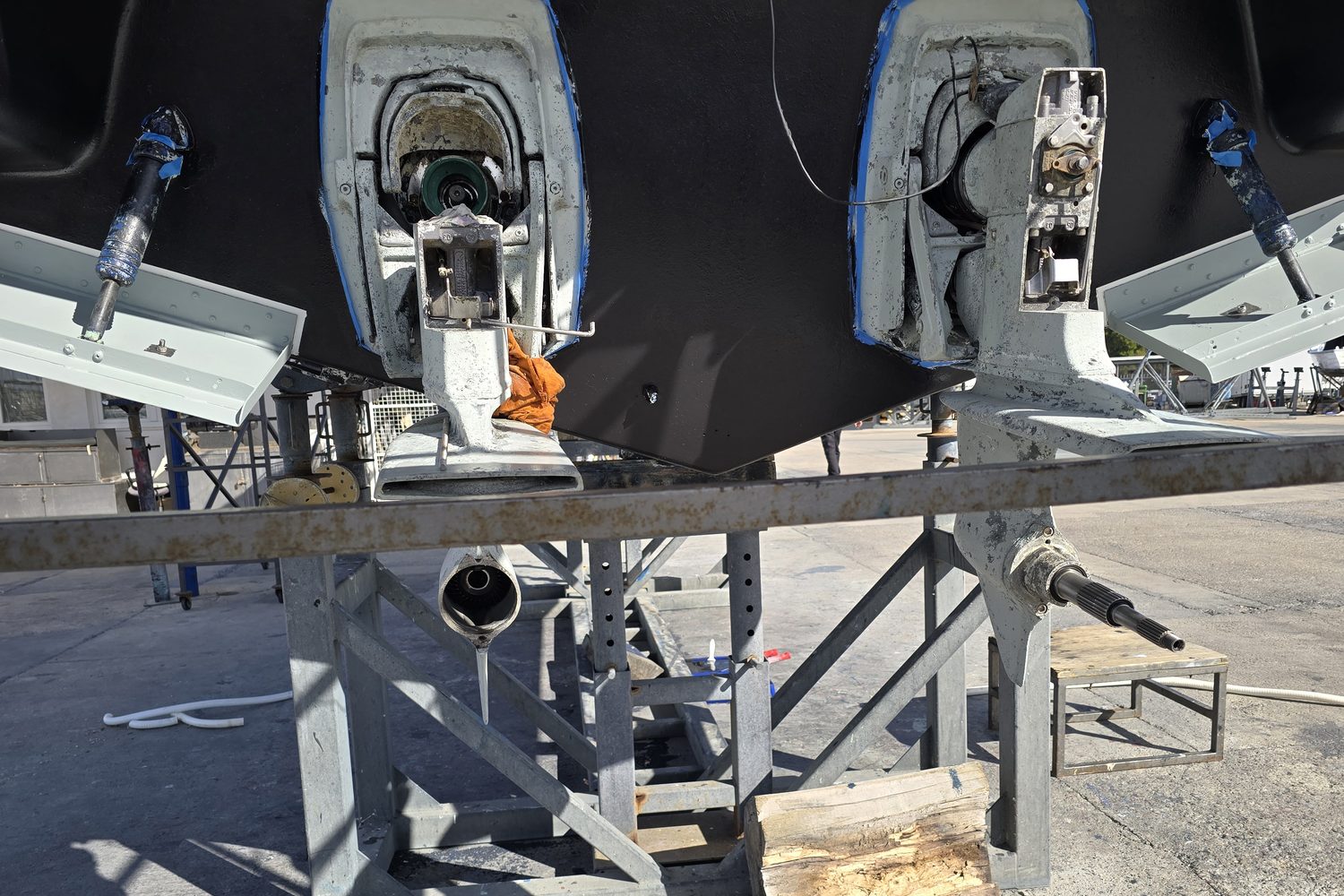
| Pod drive | Shaft seals, gear oil, anodes, oil analysis; seals under the manufacturer’s schedule after 1,200 to 3,000 engine hours depending on the series, with no calendar limit, one trade article advises about five years, always ashore; plus the oil service every year | Owners report around €2,800–5,000 for the seal service, for the pair of drives including lifting out. As a spare-part price, the 2010 trade conference named around €14,500 for a complete pod drive against around €5,400 for a sterndrive | When is the next seal service due, and what did the last one cost? |
Sources, accessed on 14 September 2026: paper by Torsten Rust, trade conference 2010 (tis-gdv.de) for the damage and spare-part values; owners’ reports on the YBW forum (25 February 2020) for the pod service; Power & Motoryacht (4 January 2018) for the advice of about five years; a pod manufacturer’s maintenance schedules (editions 04/2019, accessed on 14 October 2026, and 05/2026, accessed on 29 October 2026) for the intervals in engine hours; boat24 (23 July 2026) for outboard service life; operating manuals from an engine manufacturer (2009), figures from a seal manufacturer and BoatVerdict (June 2026) for the intervals of shaft seal and bellows, accessed on 13 October 2026.
The pod drive is demanding not because it wears faster; sources close to the manufacturers even credit it with less wear in operation. It carries the highest spare-part price in the table above, and three characteristics come together in it:
- The service is a fixed appointment, not a repair as needed: the oil service comes every year whether you have been out or not, the seals according to engine hours.
- The seal change needs the boat ashore, so lifting out and hard standing on top.
- Pod drives are practically always fitted in pairs. Everything above applies twice.
The shaft drive has few moving parts and no through-hull section that moves. The outboard is cheap in day-to-day use and, if in doubt, can be serviced yourself, but it has a foreseeable end. The sterndrive brings a recurring item that you can plan for, if you know about it.
5. What falls due when
This is the same again, sorted by age. What matters is the age of the drive, not the boat’s year of build: a repaired or replaced drive turns the clock back, and that is exactly what you ask about at the viewing.
| Drive | up to approx. 5 years | approx. 5 to 10 years | approx. 10 to 20 years | over 20 years |
|---|---|---|---|---|
| Shaft drive | Anodes, gear oil | Gland due, depending on the type; check shaft bearings and alignment | second gland change | Gearbox, shaft and P-bracket become an item |
| Outboard | Anodes, impeller, oil | major service under the manufacturer’s schedule | overhaul, depending on engine hours | plan for replacement |
| Sterndrive | Drive oil, anodes, annual visual check; under the manufacturer’s schedule in some cases the first bellows change already | bellows change due by now at the latest | further bellows changes, plus gimbal bearing and universal joints | assess the drive as a whole |
| Pod drive | annual oil service, anodes, oil analysis; seal service by engine hours, not by age | seal service once the engine hours in the manufacturer’s schedule are reached, ashore | further seal services by engine hours | check availability of spare parts and workshops |
This table gives a practical rule for the viewing: Don’t ask about the condition, ask for the date. “Runs fine” is not an answer. “Bellows changed in 2023, here’s the invoice” is. The full list of checks is in our Checklist for buying a boat.
6. The long-term items
Besides the drive, a motorboat has four more items that do not come every year, but do come:
- Engine overhaul. Depends on engine hours and care. With the engine running, a technician can estimate how far it still has to go.
- Osmosis treatment. On glass-reinforced plastic (GRP) hulls, a risk from about 10 years onwards. A survey before buying answers the question.
- Upholstery and canopies. Depending on the cruising area and UV exposure, canopies last around a decade, upholstery likewise.
- Electronics. It is not the device that is expensive but tracing faults in networked systems.
The reserve from chapter 1 is there for all four together. If you do not build it up, you pay it anyway, only all at once.
7. Annual sums: Prestige 42, built 2010, Croatia
| Type of cost | approx. per year |
|---|---|
| Berth (annual berth, including winter berth) | €5,500–11,000 |
| Insurance (third-party liability + hull) | €2,000–3,500 |
| Engine maintenance (2 × diesel) | €800–1,200 |
| Antifouling + underwater hull | €800–1,200 |
| Other maintenance, minor repairs | €2,000–3,000 |
| Total (excluding fuel and major items) | approx. €11,100–19,900 |
| Rule of thumb (€1,500 × 13 m) | approx. €19,500 |
Source: the items are guide values from market research; the rule of thumb rests on our own experience (chapter 1).
The rule of thumb sits at the upper end of the breakdown; if your berth is in an expensive marina, you will come in above it. In this table the drive appears only with its routine maintenance. The bellows change or the seal service comes on top in the year it falls due.
To put it in perspective: €19,500 a year for a boat that a sole owner realistically uses 4–8 weeks a year. Per week of actual use, that comes to around €2,400–4,900.
8. Costs by cruising area
| Cruising area | Motorboat 12–13 m, per year |
|---|---|
| Croatia / Adriatic | approx. €15,000–20,000 |
| Germany inland | approx. €10,000–13,000 |
| Baltic | approx. €12,000–16,000 |
| Lake Constance | approx. €14,000–18,000 |
| Côte d’Azur and Balearics | approx. €25,000–40,000+ |
Source: estimated ranges from market research, not calculated from individual items.
Each excluding fuel and major items. Italy is not across the board more expensive than Croatia.
9. What co-ownership (fractional ownership) changes in the sums
The costs themselves do not fall. A boat costs what it costs. What changes is your share of them: with a quarter of the Prestige 42, around €5,000 a year instead of around €19,500.
So that this also holds with people you did not know before, things happen in a set order: you get to know each other and set down in the Living Contract (co-owner agreement) who uses the boat when, who pays what and how someone leaves again, before ownership is transferred. Your share belongs to you; it is not a membership.
With the items falling due from chapters 4 and 5, this has a stronger effect than with the running costs, because they hit in a single year. A seal service or a drive overhaul falls in full on a sole owner; in a co-owner group of up to four co-owners you bear a quarter. The Living Contract settles the annual reserve for this anyway, and larger spending beyond day-to-day management you decide together; you set where that limit lies yourselves.
That brings us back to chapter 2. The alternative of “rather something older, alone” swaps a lower purchase price for the full running costs and everything that falls due. The share swaps a higher purchase price for a fraction of both.
The full calculation over 5 years, with charter alongside: For buyers
10. Frequently asked questions
How do the drives differ in running costs?
On a shaft drive the stern gland falls due approx. every 5–10 years, depending on the type; on a sterndrive the bellows do, under the manufacturer’s schedule in some cases every 2 years, usual on the market every 4–6 years (sources in chapter 4); in salt water the bellows fall due sooner than in inland waters. The outboard is cheap to maintain but, at 1,000–3,000 engine hours, has a foreseeable end. Sterndrives and pod drives bring recurring appointments, on a pod drive an annual oil service and a seal change that needs the boat ashore. Which drive suits you also depends on cruising area, draught and handling, not just on costs.
Is an older boat worth it?
Often yes; a well-kept boat with a documented maintenance history is frequently a better buy than a younger one without. Just do not confuse the lower purchase price with lower annual costs: for the same length they are roughly the same. What you also plan for with the older boat are the cyclical items that fall due in the coming years.
Do the costs fall as the boat gets older?
Partly. The boat loses less value and the hull insurance premium falls; in exchange, repairs are needed more often. The running costs therefore stay relatively stable as long as the boat is well looked after. What does not stay stable are the major items: they are not in the rule of thumb and fall due with age.
Which costs more, a motorboat or a sailing boat?
Motorboats cost more to run: higher fuel consumption, more expensive insurance, more elaborate engine maintenance. Sailing boats, on the other hand, have the rig as an additional cost factor. Rule of thumb: a motorboat costs around 50% more per metre than a sailing boat in the same cruising area. The details are in Sailing yacht running costs.
What happens with a major repair?
At PartABoat the Living Contract settles an annual reserve, and larger spending beyond day-to-day management you decide together; you set where that limit lies yourselves. You bear a surprise bill in proportion to your share, not alone.
Conclusion
With a motorboat, two things decide the annual bill that are missing from most cost lists: the drive and the timing of the next item falling due. Both can be cleared up before buying, and neither is in the listing; they are in the previous owner’s invoices.
And the sums from chapter 2 still stand: a cheaper, older boat lowers the purchase price, not the running costs. Running costs grow with every metre, not with the purchase price. As a co-owner you can buy a bigger boat than the sums would allow on your own, and you bear your share of it.
View all boats Try the cost calculator Boat chat Sell your boat or bring co-owners on board All guides
About the author: Ekki is the founder of PartABoat and a co-owner of two motorboats, one in Croatia and the other on the Rhine. The rules of thumb in this article are based on his own experience. The intervals and individual amounts for the types of drive are third-party manufacturer and market figures, marked with their sources. All figures are guide values, not a promise.